The Common App essay caps out at 650 words. The platform enforces that limit itself — paste in more, and it simply won’t take the extra text.
That’s exactly why learning how to count words in an essay matters. Write the same essay in Google Docs first, and you can land on a slightly different number than what Common App shows once you paste it in. A few hyphenated words or contractions are often enough to cause the gap, according to CollegeVine‘s admissions guidance.
Google Docs, Microsoft Word, and a submission platform’s own counter don’t all apply the same rules to the same text. This guide covers how to count words in an essay, a novel, or a blog post — what actually counts as a word, why tools disagree, and how the rules shift by document type.
How to Count Words in an Essay by Hand
Before word processors, writers estimated length by sampling. Count the words in one typical paragraph. Count how many similar paragraphs make up the piece. Multiply the two. That’s really the whole method for how to count words without a computer, and it still works today for handwritten drafts or an exam booklet with no counting tool nearby.
It’s an estimate, though, not an exact count. Paragraphs rarely match in length, and the error adds up across a full essay. A five-paragraph essay estimated this way can land 5 to 10% off — enough to break a strict limit without you knowing it. Printing the page and marking off every ten or twenty words is more accurate. It’s also slow enough to be a backup method, not your main one.
What Actually Counts as a Word?
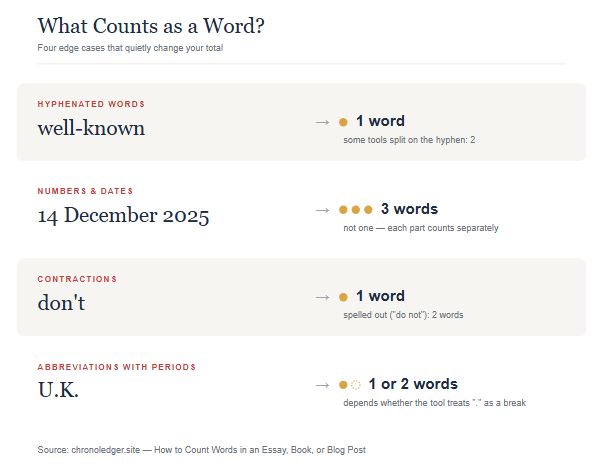
Most tools count a word as any string of characters with a space on both sides. The edge cases are where totals start to drift, and these are the word count rules for essays that catch people off guard most often:
- Hyphenated words (“well-known,” “twenty-one”) usually count as one word. Some tools split on the hyphen instead.
- Numbers count as one word each — but a written-out date like “14 December 2025” counts as three words, not one.
- Contractions (“don’t,” “it’s”) count as one word. Spell the same phrase out in full — “do not,” “it is” — and the count goes up, even though the meaning hasn’t changed.
- Abbreviations with periods, like “U.K.,” sometimes split into two words, because some tools treat the period as a break point. A human reader still sees one unit.
Titles, headers, footnotes, and citations are a separate question, and the answer depends on whoever set the word limit, not on the tool. University College London‘s Faculty of Arts and Humanities counts footnotes toward the limit, for example, but excludes the bibliography. The University of Birmingham’s thesis-submission guidance goes the other way, excluding footnotes, endnotes, and the bibliography entirely. Same country, same type of institution, two different answers.
If you’re submitting to a professor, journal, or contest, check their specific rule first. Don’t assume — the brief almost always spells it out.
Google Docs Word Count vs Word: Why They Disagree
Neither tool is broken. Google Docs and Microsoft Word were built independently of each other, and each one made its own reasonable call on the edge cases above. A few concrete examples of the same text producing different totals:
- Currency and symbols. “$615.12” counts as one word in some tools and two in others, depending on whether the symbol counts as part of the word or as a break.
- Contractions, expanded. “I don’t think this is a bad idea” comes to 8 words. Spell it out — “I do not think this is a bad idea” — and it’s 9. Same sentence, different count, purely from how the apostrophe gets treated.
- Footnotes. Google Docs includes footnote text in its word count by default. Word can be set either way, depending on your version and settings.
None of this makes one tool more “correct.” Word count isn’t one fixed standard — it’s a set of reasonable choices, made independently by each tool’s engineers. The practical fix: pick one tool as your reference for a given piece of writing, and stick with it through every draft. If the platform you’re submitting to has its own built-in counter, like Common App’s, trust that number over whatever your word processor shows. That’s the one that actually enforces the limit.
Novel Word Count by Genre
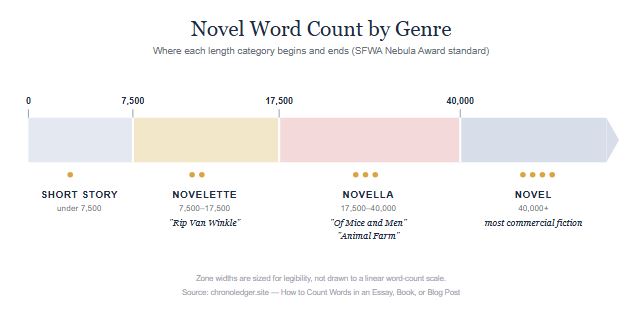
Word count categories aren’t just an academic problem. Fiction has its own, and they’re stricter than most writers expect. The standard comes from the Science Fiction and Fantasy Writers Association‘s Nebula Award rules, now used informally across genres well beyond science fiction:
| Category | Word count | Example |
|---|---|---|
| Short story | Under 7,500 words | — |
| Novelette | 7,500–17,500 words | Rip Van Winkle |
| Novella | 17,500–40,000 words | Of Mice and Men, Animal Farm |
| Novel | 40,000+ words | Most commercial fiction |
Most published debut novels run well past that 40,000-word floor. 70,000 to 90,000 words is typical for adult fiction. Genre still moves the number around — fantasy tends to run longer, category romance shorter.
The 50,000-word mark carries its own weight, separate from genre. It’s the target popularized by NaNoWriMo, the annual writing challenge that ran every November from 1999 until the nonprofit behind it announced its closure in spring 2025, after years of funding trouble. The organization itself is gone, but the challenge wasn’t retired with it. ProWritingAid relaunched the same format later that year under a new name, Novel November, with authors including Madeline Miller taking part.
How to Hit a Word Count Target Without Padding
Under your target? Resist the urge to add filler. Vague qualifiers, repeated points, and restated transitions are easy for a professor or editor to spot, and they weaken a piece more often than they strengthen it. Add real content instead — another example, a counterargument you haven’t addressed yet, more specific evidence for a claim you’ve only asserted.
Over your target? Cut redundant phrasing before you cut ideas. Swap “due to the fact that” for “because.” Swap “at this point in time” for “now.” Small trims like these routinely cut 10 to 20% off a draft’s length, with none of the actual points lost. Passive constructions tend to run long too — “a decision was made by the committee” versus “the committee decided.” Our guide to passive voice and readability covers how to spot and fix them.
For more on trimming length without losing meaning, see our guide to writing shorter sentences. Our plain language guide covers cutting jargon that adds words without adding value.
Either way, check your count against the actual rule you’re working with. A strict maximum, a target with some margin, and a hard minimum call for different edits — know which one you’re dealing with before you call a draft finished.
Check Your Own Word Count
Paste your draft into ChronoLedger’s checker for an instant word count, plus reading time and a Flesch reading ease score from the same text. No more reconciling numbers across tools by hand.
FAQ
Does word count include the title and headers? It depends on who set the rule. Some academic and publishing conventions exclude the title, headers, and reference list while still counting the body text and footnotes. Others exclude footnotes too. Check the specific guidelines for what you’re submitting — the answer genuinely varies by institution and publisher.
Why does Google Docs give a different count than Microsoft Word? The two tools handle edge cases differently. Hyphenated words, symbols, footnotes, and abbreviations with periods can all come out differently on identical text. Neither tool is wrong — they’re just following different, reasonable rules for the same ambiguous cases.
Do hyphenated words count as one word or two? Most tools count a hyphenated word like “well-known” as one word. Some split on the hyphen instead, which is one of the more common sources of small discrepancies between counters.
How many words is a short story versus a novel? By the SFWA’s widely-used standard: short stories run under 7,500 words, novelettes 7,500–17,500, novellas 17,500–40,000, and novels 40,000 words or more. Most published novels run well past that minimum — typically 70,000 to 90,000 words.
How do I count words in an essay without a computer? Sample a typical paragraph, count its words, and multiply by the number of similar paragraphs for a rough estimate. For more precision, print the page and mark off every ten or twenty words as you go. Both work, but they’re slower and less exact than a digital tool.
Where to Go From Here
Word count feels like it should be one fixed number. It’s really a set of choices — what counts as a word, what sections count at all, and which tool you trust to add it up. Now that you know how to count words in an essay, a novel, or a blog post, the fix is simple: know which rule applies to what you’re writing, pick one tool as your reference point, and check the actual requirement before you call a draft finished.
Paste your own draft into ChronoLedger’s checker to see its word count, reading time, and readability score, all at once.
Pingback: 1,500-Word Essay Too Long? A Step-by-Step Trimming Checklist - chronoledger.site
Pingback: Sentence Counter: How Many Sentences Should an Essay or Article Have? - chronoledger.site
Pingback: Online Spell Check vs. Grammar Check: Do You Need Both?