Word count gets all the attention. But sentence count is what actually decides how your writing feels. A 500-word essay written in 15 sentences reads nothing like the same 500 words split into 40. One feels heavy. The other feels rushed.
If you’ve ever stared at a draft wondering “is this too dense, or too choppy?” — you’re asking a good question. You’re just aiming it at the wrong number. Word count won’t answer that. Sentence count will.
Word Counter vs. Sentence Counter
A word counter tells you how much you wrote. A sentence counter tells you how you wrote it.
Word counters just add up total words. Useful for hitting a limit — a 500-word essay, a caption with a character cap. But it says nothing about pacing.
A sentence counter goes further. It shows you:
- Total sentences
- Average words per sentence
- Your longest and shortest sentence
- Often, a readability score like Flesch Reading Ease
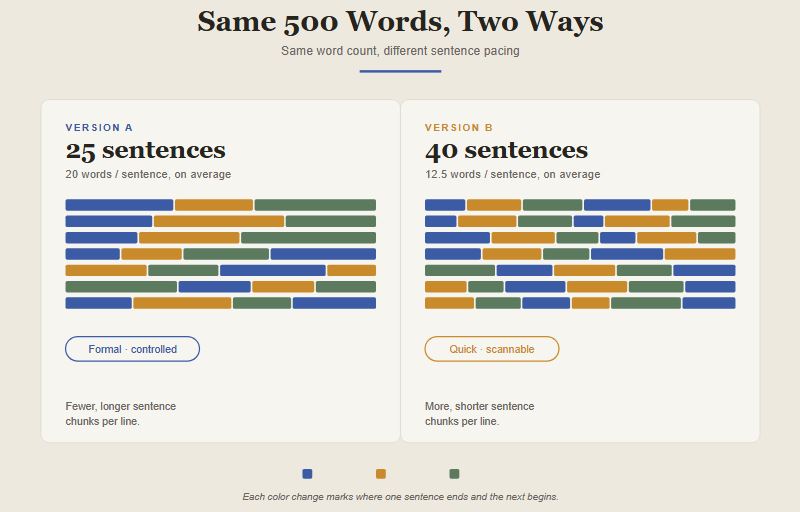
Here’s why that matters. Two pieces of writing can share the exact same word count and still read completely differently. Take 500 words split into 25 sentences — that’s 20 words per sentence, which reads as formal and controlled. Split those same 500 words into 40 sentences instead, and you get 12.5 words per sentence — quick, plain, easy to skim on a phone.
Same word count. Same topic, even. Two different reading experiences. Sentence count is what separates them.
How Many Sentences Should Your Writing Have?
There’s no single correct number. But there are ranges that hold up across most writing, and they give you something real to check a draft against.
Essays
| Essay length | Typical sentence count | Avg. words per sentence |
|---|---|---|
| 500 words (short essay) | 25–35 sentences | 14–20 words |
| 1,000 words (standard essay) | 50–65 sentences | 15–20 words |
| 2,000+ words (research paper) | 100–135 sentences | 15–20 words |
Academic paragraphs usually run 4–7 sentences: a topic sentence, some evidence, some analysis. A five-paragraph essay with five sentences per paragraph gives you 25 sentences total — that’s the floor, not a target to aim for. Most solid undergraduate essays land closer to 6–8 sentences per body paragraph.
Quick check: Fewer than 20 sentences in a 500-word essay means you’re averaging 25+ words each. That’s dense — worth a second look. More than 45 sentences, and you’re under 11 words each, which usually reads as choppy for academic work.
Blog Posts and Web Content
| Content length | Typical sentence count | Avg. words per sentence |
|---|---|---|
| Short post (800 words) | 45–58 sentences | 14–18 words |
| Standard post (1,200 words) | 65–82 sentences | 14–18 words |
| Long-form (2,000+ words) | 110–135 sentences | 15–18 words |
Web readers scan more than they read line by line. Keep paragraphs to 2–4 sentences. Research from the American Press Institute, based on a study of hundreds of newspapers, found reader comprehension near 100% when sentences average 8 words, still above 90% around 14 words, and below 10% once the average climbs to 43 words. You don’t need to write in 8-word sentences all day — that gets robotic fast — but that drop-off is a good reason to watch your average once it passes 25 words.
Quick check: A paragraph past 6 sentences starts to look like a wall of text on a phone screen. Break it up.
Product Descriptions and Marketing Copy
| Copy type | Typical sentence count | Avg. words per sentence |
|---|---|---|
| Short product description (50–75 words) | 5–8 sentences | 9–13 words |
| Standard product page (150 words) | 12–17 sentences | 9–13 words |
| Landing page hero section | 2–4 sentences | 7–11 words |
Marketing copy sells. It doesn’t explain. Short sentences read as confident: “You have one job. Do it well.” Two sentences, no ambiguity.
Quick check: If your product description averages past 18 words a sentence, you’re probably explaining when you should be persuading.
Sentence Count Alone Doesn’t Tell You Much
Here’s the part most sentence-counter guides skip: the number by itself doesn’t tell you if your writing is any good.
A 30-sentence paragraph can be sharp and clear — if the sentences average 15 words and each one carries a single idea. Or it can be exhausting — if every sentence runs 25+ words and stacks three ideas behind a string of commas.
A 10-sentence paragraph works the same way. It can read as punchy, if the lengths vary — some 6 words, some 18. Or it can read as robotic, if every sentence lands at exactly 8 words.
What actually matters:
- Average length. Aim for 15–20 words for a general audience.
- Variety. Mix short (5–10 words), medium (10–20 words), and the occasional longer sentence (20–30 words).
- One idea per sentence. If a sentence has three commas and a “which” clause, it’s probably two sentences wearing a trench coat.
A rough rhythm that works for most writing: about a fifth of your sentences short — under 10 words — for emphasis, roughly 60% in the 10–20 word range doing the actual work, and the rest a bit longer, for the ideas that need more room. Very few sentences should run past 30 words.
Stop counting sentences and start reading them out loud instead. A 25-sentence paragraph with clear, varied sentences beats a 15-sentence paragraph where every sentence is a 30-word run-on.
A Real Before-and-After Example
Here’s a sentence pulled from a typical first draft:
Because sentence length directly influences reader comprehension, and because comprehension tends to decline sharply once average sentence length exceeds twenty to twenty-five words, writers who want their work to be accessible to a general audience should pay close attention to how many words they pack into each sentence, especially in the opening paragraphs where first impressions are formed.
One sentence, 58 words. Run it through the Flesch Reading Ease formula and it scores around -1 — off the bottom of the 0–100 scale. “Very difficult” doesn’t even cover it.
Now split it up:
Sentence length affects comprehension. Once sentences pass twenty to twenty-five words, understanding drops fast. That matters most in your opening paragraph, where readers form their first impression.
Same idea. Three sentences, 27 words total, 9 words per sentence on average. Flesch score: around 47. Still on the harder side of the scale, but a jump of nearly 50 points from one edit. Nothing was cut from the idea — it just got its own sentence.
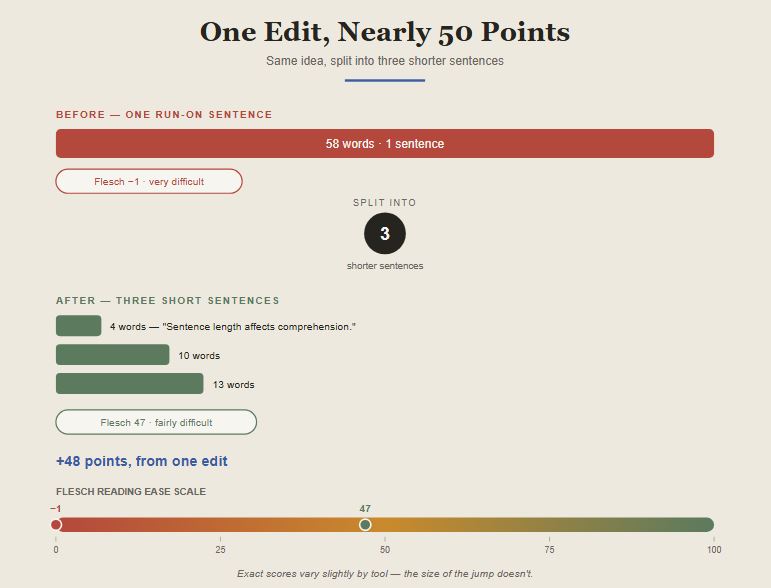
Exact scores shift slightly depending on which readability tool you use, since they count syllables a little differently. The direction and the size of the jump hold either way.
How to Check Your Sentence Count Without Doing It by Hand
Nobody’s counting periods with a highlighter. Here’s what actually works.
Microsoft Word. Go to File → Options → Proofing and check “Show readability statistics.” Run spell check (F7), and Word shows sentence count, average sentence length, and a Flesch score in the popup. It only updates after a spell check, so it’s not live, but it’s built in and reliable.
Google Docs. Docs shows word count (Tools → Word Count) but has no built-in sentence counter. Workaround: select all, copy, and paste into Word or a free online sentence counter. Ten seconds, done.
PDFs. Select all the text, copy it, and paste it into the same tools above. If the count looks obviously wrong, the PDF’s formatting probably broke on copy — paste into a plain text editor first, then into your counter.
While you write. Grammarly and the Hemingway App both flag long sentences as you type, which catches the problem mid-draft instead of after you’ve finished.
Put Sentence Targets in Your Content Brief
If you manage other writers, don’t just tell them to “keep sentences short.” Put an actual range in the brief, the same way you’d specify word count: “1,200 words, aim for 65–80 sentences, average sentence length under 18 words.”
That turns a vague style note into something a writer can check their own draft against before they send it to you — and something you can verify without reading every line yourself.
The Bottom Line
Sentence count isn’t a target to hit. It’s a diagnostic to run.
- Essays: 25–35 sentences for 500 words, 50–65 for 1,000 words.
- Blog posts: 14–18 words per sentence on average, 2–4 sentences per paragraph.
- Marketing copy: 9–13 words per sentence, short paragraphs.
For anything in between, use the formula: word count ÷ target average sentence length = target sentence count. A 700-word piece aiming for 16 words a sentence needs roughly 44 sentences. If your actual count is way off from that, something in your pacing is worth a second look.
Check your draft with a sentence counter. But don’t write for the number — write for the sentence, and let the number confirm you got it right.
Related posts:
How to Count Words in a PDF (3 Free Methods)