Last updated: July 27, 2026
Almost every article about short writing tells the same story. Hemingway supposedly won a bar bet by writing a six-word story: “For sale: baby shoes, never worn.” There’s just one problem. No real evidence links Hemingway to that story.
Quote Investigator and Snopes both checked the history. The earliest known link to Hemingway comes from a 1989 stage play — nearly 30 years after he died. Similar wording shows up in newspaper ads as far back as 1906, when Hemingway was seven years old.
The myth survives because the lesson feels true, even though the story isn’t. Fewer words really can carry the same weight — sometimes more. This guide covers real ways to shorten sentences without losing meaning. It also covers something most advice skips: when a longer sentence is the right choice.
Table of Contents
- Why long sentences hurt readability
- The one-idea-per-sentence rule
- Splitting compound sentences
- Cutting filler and hedging language
- When a longer sentence is the right call
- Test your sentence length now
- FAQ
- Where to go from here
Why long sentences hurt readability
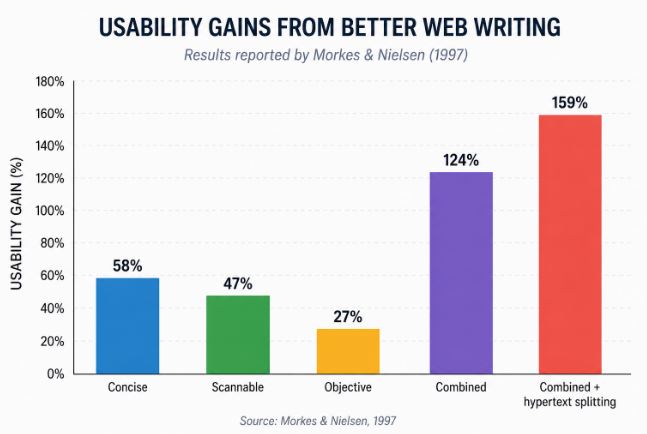
This isn’t just a style preference. It’s measurable. In 1997, researchers John Morkes and Jakob Nielsen tested this on real pages from Sun Microsystems’ website. They cut the writing down to about half its original length, made it easier to scan, rewrote it in a plainer and less promotional tone, and split long pages into shorter, linked ones. Measured usability jumped 159%. Concise writing didn’t just look cleaner — it changed how well people could actually use the page.
The reason comes down to memory. Every extra clause is one more thing the reader has to hold onto before reaching the point. That’s friction. A short sentence delivers its idea and lets go. That’s part of why short sentences tend to score in the “very easy” range on the Flesch Reading Ease scale.
There’s a math reason behind this, too, and it’s worth knowing — it tells you what to fix first. The Flesch-Kincaid Grade Level formula weighs word length about 30 times more heavily than sentence length. The Flesch Reading Ease score weighs it even more, roughly 80 times more. In both formulas, cutting a few long words usually moves your score more than trimming a sentence does. That’s why the tips below cover word choice as much as sentence length.
Want the full breakdown of that formula? Read our guide to the Flesch Reading Ease score.
The one-idea-per-sentence rule
The fastest way to spot a sentence that needs shortening isn’t counting words. It’s counting ideas. If a sentence is doing more than one job, split it.
Before: “The report, which was compiled by three different departments over six weeks and reviewed twice before publication, ultimately recommended delaying the launch.”
That sentence packs in three facts: who compiled the report, how it was reviewed, and what it recommended. Split by idea:
After: “Three departments compiled the report over six weeks, and it was reviewed twice before publication. It ultimately recommended delaying the launch.”
Nothing got cut. The information is the same. The reader no longer has to hold three threads at once.
Splitting compound sentences
Look for sentences joined by “and,” “which,” or “while.” If each half could stand on its own, that’s usually where a natural split lives. (“Because” clauses work differently — see the note below.)
Before: “The homepage was redesigned last quarter, and while feedback has been largely positive, a few users have reported confusion about the new navigation, which the team is currently investigating.”
After: “The homepage was redesigned last quarter. Feedback has been largely positive. A few users have reported confusion about the new navigation. The team is looking into it.”
This isn’t a rule for every sentence. Sometimes both halves need to stay connected, because one half explains or depends on the other. Ask yourself one thing: does the reader lose anything by pausing between the two ideas? If not, split it.
A note on “because”: a sentence that starts with “Because X” isn’t complete on its own. It’s a dependent clause, not a full sentence. If you split off a “because” clause, keep it attached to a subject and a verb, like “This happened because X.” Don’t let it stand alone as a fragment.
Cutting filler and hedging language
Some words add length to a sentence without adding meaning. The most common offenders:
- Filler words: really, very, just, actually, basically, essentially
- Redundant lead-ins: “It is important to note that…”, “The fact of the matter is…”
- Weak verb constructions: “conduct an analysis of” instead of “analyze”; “make a decision” instead of “decide”
- Wordy phrases: “in order to” instead of “to”; “in the event that” instead of “if”
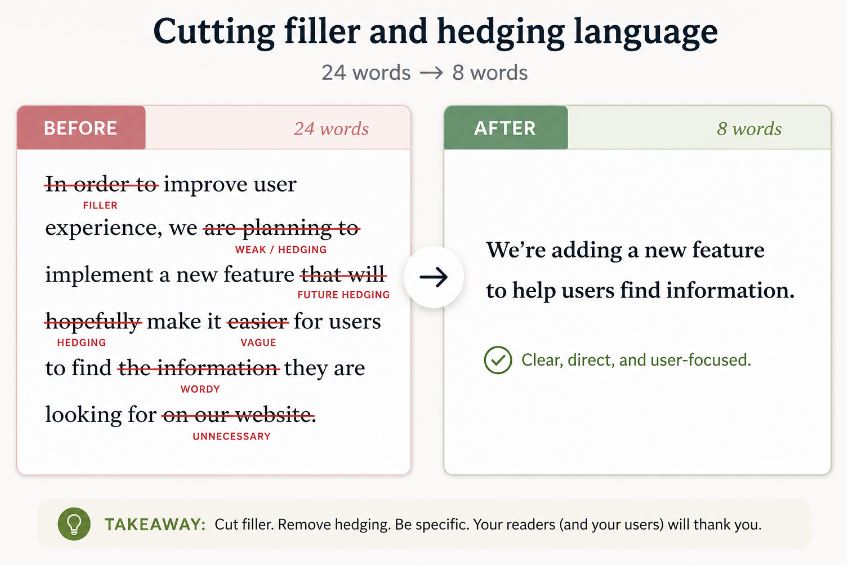
Before: “It is important to note that, in order to improve performance, we made the decision to conduct a comprehensive review of the current system.”
After: “To improve performance, we reviewed the current system.”
That’s a drop from 24 words to 8. The meaning didn’t change. This is also the fastest way to move a readability score. That’s because it targets exactly the syllable-heavy words the Flesch formulas weigh most. Swapping “conduct a comprehensive review of” for “review” moves your score more than restructuring the whole sentence would.
When a longer sentence is the right call
Shortening has exceptions. Ignoring them causes real problems in two cases.
Legal and technical precision. Some sentences list exact conditions, like this one: “the policy covers water damage caused by burst pipes, but not damage resulting from prolonged exposure to moisture or inadequate maintenance.” Sentences like this often need to stay whole. Splitting them can detach a condition from the thing it describes, and that can quietly change the meaning.
Rhythm and emphasis. A page of only short sentences feels choppy and flat. That’s its own readability problem — just a different one than long, tangled sentences. Build toward a point with a longer sentence, then land it with a short one. That often works better than either style alone. Vary the length on purpose. Don’t make every sentence the same size.
Use the same test from the one-idea rule, but run it in reverse: does splitting this sentence lose or distort something the reader needs? If yes, keep it whole.
Test your sentence length now
Paste your draft into ChronoLedger’s sentence checker. It shows your average sentence length and flags the individual long sentences, so you know exactly which ones to fix first.
FAQ
What’s a good average sentence length for web content? Most guidance for web content suggests an average of 14 to 20 words per sentence. Mix shorter and longer sentences rather than keeping every sentence the same length.
Does shortening my sentences always improve my readability score? Usually, yes. But in both Flesch formulas, word choice carries more weight than sentence length. Cutting one syllable-heavy word can move your score more than trimming a few short words. For the full breakdown, see our guide to the Flesch Reading Ease score.
Is it true that Hemingway wrote a famous six-word story to prove brevity works? Almost certainly not. No real evidence connects Hemingway to “For sale: baby shoes, never worn.” The earliest known link to him comes from a 1989 stage play. Similar wording in classified ads shows up years before Hemingway’s career even began.
Should every sentence in my writing be short? No. A page of only short sentences creates its own problem: a flat, monotonous rhythm. Vary your sentence length on purpose. Keep the longer ones where splitting would lose important precision.
Where to go from here
Shortening a sentence doesn’t make the idea smaller. It just cuts what wasn’t carrying any weight. Start with the one-idea rule to spot the easy splits. Then target filler words and weak verbs — they move your score fastest. Keep the sentences that need their full length for precision or rhythm.
Paste your own draft into ChronoLedger’s checker. It’ll show you exactly which sentences are dragging your average length up.
Pingback: Plain Language Writing: A Practical Guide to Cutting Jargon - chronoledger.site
Pingback: How to Count Words in an Essay, Book, or Blog Post - chronoledger.site
Pingback: Punctuation Checker: 7 Common Mistakes (and What It Misses)