Last updated: July 28, 2026
In June 2023, the International Organization for Standardization published the first global standard for plain language: ISO 24495-1. Experts from 25 countries and 19 languages helped write it. Their goal was simple: define writing that readers can find, understand, and use on the first try.
It took years to formalize something most writers assume is common sense. That gap is worth noticing. It tells you plain language is harder to define, and easier to get wrong, than it looks.
Every editor who has cut jargon from a draft has seen the same thing happen. A reader skims past nine good sentences, hits one word they don’t recognize, and stops reading. One bad word choice can undo a lot of good writing.
This guide covers four things:
- What plain language actually means
- How to cut jargon, industry by industry
- A real test for whether your writing qualifies
- Why simplifying isn’t the same as talking down to your reader
Table of Contents
- What plain language actually means
- Jargon-to-plain-English swaps by industry
- The plain-language test
- Plain language isn’t oversimplified
- Check your draft’s readability
- FAQ
What plain language actually means
Plain language isn’t a modern marketing trend. Its clearest early rules come from George Orwell’s 1946 essay, “Politics and the English Language.” Orwell gave writers four rules that still hold up: use a short word instead of a long one, cut any word you don’t need, prefer active voice over passive, and skip jargon whenever a plain word will do.
Those four rules cover most of what good writing guides teach today. Plain language is really the idea that ties them all together.
The idea later became law. The U.S. Plain Writing Act of 2010 requires federal agencies to write in plain language for the public. The CDC’s health literacy guidelines go further, with concrete numeric targets: aim for about 20 words per sentence, one idea per sentence, and no more than five sentences per paragraph.
ISO 24495-1 builds on the same foundation. It sets out four principles a plain-language document must meet:
- Relevance — The reader can tell right away whether this applies to them.
- Findability — The reader can locate what they need without reading the whole document.
- Understanding — The reader gets it on the first read.
- Usability — The reader can act on it: fill out the form, follow the steps, make the decision.
Usability is the last test, and the most important one. A document can be relevant, findable, and clear, and still fail if the reader can’t actually use it.
The standard keeps growing. ISO published a new part on science writing in May 2026. It applies these same four principles to technical and research communication.
Jargon-to-plain-English swaps by industry
Jargon isn’t always wrong. Inside a specialist audience, a precise term can be the clearest choice available. The problem starts the moment that audience gets wider — when a lawyer writes for clients, or a doctor writes for patients.

Here are common swaps, by field.
Legal
- “pursuant to” → “under” or “according to”
- “in the event that” → “if”
- “prior to” → “before”
- “shall” → “will” or “must” (pick based on the obligation you mean)
Medical and health
- “hypertension” → “high blood pressure”
- “myocardial infarction” → “heart attack”
- “administer” → “give”
- “adverse event” → “side effect” or “harmful reaction”
Technology
- “leverage” → “use”
- “utilize” → “use”
- “onboard” (as a verb) → “get started” or “set up”
- “bandwidth” (meaning free time) → “time” or “capacity”
Business and corporate
- “circle back” → “follow up”
- “synergy” → “combined effect”
- “low-hanging fruit” → “easy wins”
- “at this point in time” → “now”
Notice the pattern. Jargon is rarely more precise than the plain version. It’s just more familiar to people who already work in that field.
The plain-language test
Skip the vague “does this feel simple enough?” gut check. Instead, run your draft against the same four principles ISO uses:
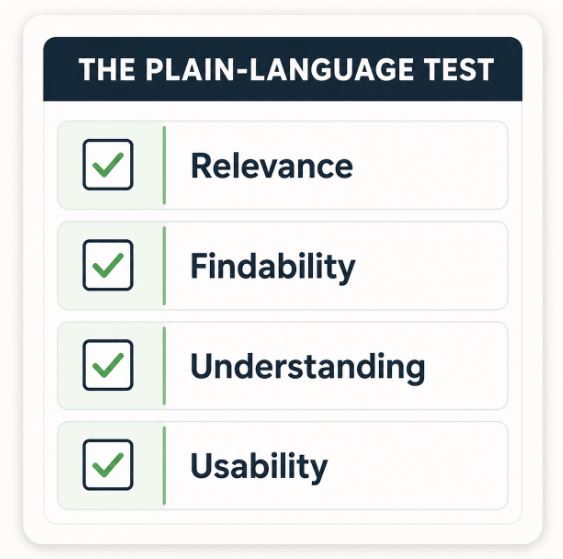
- Relevance — Does this address what the reader came here for? Cut anything that doesn’t.
- Findability — Can a reader find the one piece of information they need, using your headings, without reading everything?
- Understanding — Can someone outside your field read this once and get it, with no need to look anything up?
- Usability — Can the reader actually act on this?
Each test points to a different fix. A draft that fails “understanding” needs less jargon. A draft that fails “findability” needs better headings, not simpler words. Treat these as four separate checks. That makes it much easier to see exactly what to fix.
Plain language isn’t oversimplified
This is the fear that stops a lot of writers from trying plain language: that cutting jargon means losing nuance, or that short sentences sound condescending.
That fear doesn’t hold up. The ISO standard is about whether readers can find, understand, and use your writing. It isn’t about making the ideas themselves simpler. A complex idea explained in plain language is still complex. It’s just no longer wrapped in extra difficulty on top of that.
Look back at the medical swap above: “myocardial infarction” and “heart attack” describe the exact same event, with the exact same severity. Nothing about the condition got simpler. Only the label did.
Keep the technical terms your audience genuinely needs. The federal government’s own plain-language guidelines make the same point: jargon is a problem when it’s used to sound smart instead of to communicate clearly. A necessary technical term, used clearly, isn’t jargon. It’s just vocabulary. The goal isn’t zero specialized language. It’s zero specialized language that isn’t earning its place.
Check your draft’s readability
Reading your own writing with fresh eyes is hard. A readability tool helps you catch what you can’t see anymore: sentence length, word choice, and which specific terms are quietly losing your reader.
Paste your draft into ChronoLedger’s checker to see how your word choices affect your score. You’ll get a clear list of which terms are worth simplifying first.
FAQ
What is plain language, exactly? Writing that lets your intended reader find what they need, understand it, and use it. That’s the definition behind ISO 24495-1, published in 2023.
Does plain language mean “dumbing down” my writing? No. It changes how you express an idea, not how complex the idea is allowed to be. Keep the technical terms your specific audience needs.
Is there an actual standard, or is this just a style preference? There’s a real one: ISO 24495-1:2023. The U.S. also has the Plain Writing Act of 2010, which sets requirements for federal communications.
How long should a plain-language sentence be? There’s no hard rule. But the CDC’s guidelines point to about 20 words per sentence, with one idea per sentence, as a practical target.
Can I ever use jargon in plain-language writing? Yes, when your audience already knows the term and it genuinely helps. The problem isn’t specialized language. It’s language used to sound impressive instead of to communicate.
Where to go from here
Plain language has real backing behind it, from Orwell’s 1946 rules to a 2023 international standard. None of that is about making your writing less sophisticated. It’s about making it less obstructed.
Run your draft against the four-principle test above. Swap out any jargon that isn’t earning its place, using the industry examples here as a starting point. Keep the technical terms your audience genuinely needs.
Then check your draft’s readability with ChronoLedger’s checker, or read our guides on writing shorter sentences and active vs. passive voice — the other two pillars of the same idea.
Pingback: Email Readability Tips for Marketing That Actually Converts - chronoledger.site
Pingback: How to Count Words in an Essay, Book, or Blog Post - chronoledger.site
Pingback: What Reading Level Should a Blog Post Be? A Grade-Level Guide by Content Type - chronoledger.site
Pingback: Dale-Chall Readability Formula: How It Differs From Flesch-Kincaid
Pingback: How to Write Shorter Sentences Without Losing Meaning - chronoledger.site