Last updated: July 26, 2026
A Flesch Reading Ease score can go negative. It can also climb past 100 — all the way to 121.22, the mathematical ceiling, reached only by a sentence built entirely out of one-syllable words. If you’ve ever run your writing through a tool, gotten a number outside the range you expected, and assumed something broke, you’re in good company. Most explainers of this score skip that detail entirely: the scale has a ceiling, but no floor.
That’s usually the moment someone stops chasing a target number and starts asking what a Flesch Reading Ease score is actually measuring. This guide walks through the formula in plain terms, what the 0–100 range means depending on what you’re writing, and the specific ways the score gets misread — including a case where it rates a novel written for adults at a sixth-grade level.
Table of Contents
- The Flesch Reading Ease formula, in plain English
- Why word length moves your score more than sentence length does
- The 0–100 scale, explained
- What a “good” score looks like, by content type
- Common misconceptions about the Flesch Reading Ease score
- What Yoast quietly changed about this score
- Three edits that actually move the number
- Check your own text’s score
- FAQ
- Where to go from here
The Flesch Reading Ease formula, in plain English
The Flesch Reading Ease score comes from exactly two inputs: how long your sentences are, and how long your words are. Rudolf Flesch built the formula in the 1940s while consulting for the Associated Press on newspaper readability, and published it in 1948 in the Journal of Applied Psychology under the title “A New Readability Yardstick.”
The formula itself:
206.835 − (1.015 × average sentence length) − (84.6 × average syllables per word)
Average sentence length is total words divided by total sentences. Average syllables per word is total syllables divided by total words. Plug both into the formula and you get a number, usually somewhere between 0 and 100, where higher means easier to read.
A short, plain sentence like “The cat sat on the mat” scores around 116 — near the top of the scale. Rewrite the same idea with longer words and more clauses — “The domesticated feline reclined upon the woven floor covering” — and the score falls to roughly 19, even though the sentence is still just nine words long and the meaning barely changed.
Why word length moves your score more than sentence length does
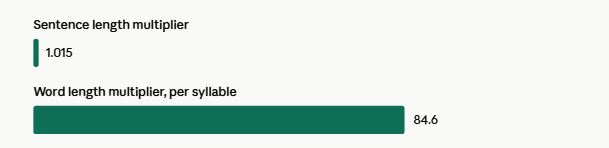
Look at the two multipliers in the formula: 1.015 for sentence length, 84.6 for syllables per word. That gap isn’t small — it’s roughly 83 points. Swapping a handful of long words for shorter ones will typically move your score further than trimming a sentence by a few words.
If you’re editing toward a specific number, that’s where to spend your effort first. Cutting “utilize” to “use” or “approximately” to “about” does more for your score than breaking one sentence into two.
The 0–100 scale, explained

Here’s the standard breakdown, drawn from Flesch’s original scale and consistent with how it’s used across publishing, education, and government writing today:
| Score | Readability level | Roughly understood by |
|---|---|---|
| 90–100 | Very easy | An average 11-year-old |
| 80–89 | Easy | Middle school students |
| 70–79 | Fairly easy | Teens aged 13–15 |
| 60–69 | Standard / plain English | High school students |
| 50–59 | Fairly difficult | College students |
| 30–49 | Difficult | University graduates |
| 0–29 | Very difficult | Specialists and academics |
| Below 0 | Extremely dense | Highly technical or specialist text only |
Two things most benchmark tables leave out:
The scale has a ceiling, but no real floor. The mathematical maximum is 121.22, reached only by text made up entirely of one-syllable words. There’s no equivalent minimum — extremely dense, jargon-heavy, or highly technical writing can score negative, and that’s not an error. A 2026 analysis of NeurIPS machine-learning papers found average Flesch scores falling from roughly 24 in 1987 to about 13 in 2024, and still dropping. That’s normal for that kind of writing, not broken.
The exact grade-level boundaries vary slightly by source. You’ll find tables that place 60–70 at “grade 8” and others that place it at “grade 8–9.” That’s not sloppiness on any one source’s part — it reflects small differences in how various publishers have translated the same underlying score into U.S. school grades over the decades. Treat the table above as a solid general guide, not a precise, universally agreed-upon conversion.
What a “good” score looks like, by content type
There’s no single “good” score — it depends entirely on what you’re writing and for whom.
| Content type | Typical target range |
|---|---|
| General web content / blog posts | 60–70 |
| Marketing and consumer copy | 70–80 |
| Technical documentation | 40–60 |
| Academic writing | 30–50 |
| Legal documents (traditional) | 10–30 |
These aren’t arbitrary house rules. Florida law (F.S. 627.4145) requires most insurance policies sold in the state to score at least 45 on the Flesch Reading Ease test before regulators will approve the wording. And the readability push the U.S. Navy started in the 1970s — commissioning researcher J. Peter Kincaid to adapt Flesch’s formula into a grade-level score for technical training manuals — led the U.S. Army to adopt it as a full Military Standard for manual writing by 1978.
If you write for a general audience — a blog, a landing page, a how-to guide — 60 to 70 is a reasonable target. If you’re writing for specialists who expect precision and technical vocabulary, a lower score isn’t a failure; it’s appropriate to the audience.
Common misconceptions about the Flesch Reading Ease score
A high score means good writing. It doesn’t. The score measures sentence length and word length — nothing else. It says nothing about accuracy, structure, or whether the content actually matches what the reader needs.
Colleen Hoover’s novel It Ends With Us is a useful real-world example. Its plain vocabulary and conversational dialogue put it at roughly a sixth-grade reading level on the Flesch scale. Yet most teachers and librarians recommend the book for adult and college-age readers, because of mature subject matter the formula has no way to detect — it only counts syllables and sentence length, not content.
The reverse happens just as often. A carefully hedged clinical trial abstract or a tightly reasoned legal brief can score in the single digits and still be excellent writing for the audience it’s written for. A low score isn’t a defect, any more than a high one is automatically a badge of honor — it just means the vocabulary and sentence structure are doing what that particular audience needs.
It’s a grammar or tone checker. It isn’t. The Flesch Reading Ease score doesn’t evaluate grammar, passive voice, spelling, or word choice beyond syllable count. If you want a grade-level number instead of a 0–100 score, that’s a related but separate metric — the Flesch-Kincaid Grade Level, which uses the same two inputs with different weighting.
“A negative or over-100 score means the tool is broken.” Also false, and covered above — the scale simply doesn’t have a floor, and dense or technical writing can legitimately score below zero.
“It’s a confirmed Google ranking factor.” No. Google has said plainly that readability scores aren’t used as a direct ranking signal, and the data backs that up: the digital marketing agency Portent analyzed the reading level of more than 750,000 pieces of content across roughly 30,000 search queries and found no correlation between Flesch or grade-level scores and where a page ranked. Readability can still matter indirectly, through engagement and time on page, but treating it as a ranking hack is a myth.
What Yoast quietly changed about this score
Here’s something most explainers of this metric skip entirely: Yoast SEO — the plugin most responsible for putting the Flesch Reading Ease score in front of everyday bloggers — stopped using it as the primary readability signal in version 19.3, released in 2022. The score is still there, tucked into the plugin’s Insights tab, but Yoast now leads with two separate checks instead: one for sentence length, one for word complexity.
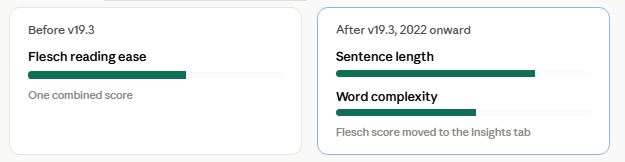
Yoast’s own explanation for the change is worth knowing. The Flesch score folds two different problems into a single number, so a low score alone doesn’t tell you whether your sentences are too long, your vocabulary is too complex, or both. Splitting the two apart gives a writer something concrete to fix instead of a number to stare at.
The takeaway holds no matter which tool you use. If your score comes back lower than expected, don’t start cutting words at random — check whether the drag is coming from sentence length, word choice, or both, and edit the one that’s actually the problem.
Three edits that actually move the number
You don’t need to overhaul a draft to shift a Flesch score meaningfully. Three edits do most of the work:
- Swap Latinate words for plain ones first. “Utilize” to “use,” “facilitate” to “help,” “sufficient” to “enough,” “additional” to “more.” Because the formula weights syllables so heavily, this single habit moves the score more than almost anything else you can do.
- Split sentences at “and,” “which,” and “because.” A 30-word sentence carrying two ideas usually reads better — and scores better — as two shorter ones. You’re not losing information, just giving the reader a place to breathe.
- Read the sentence out loud. If you run out of breath before you hit the period, that’s usually the sentence dragging your score down. It’s a faster diagnostic than staring at the number itself.
None of this means writing short and simple no matter what. It means knowing which sentence is actually the problem before you start editing.
Check your own text’s score
Paste any draft into ChronoLedger’s free Flesch Reading Ease checker to see your score instantly, broken down by what’s actually driving it — long sentences, complex vocabulary, or both — so you know exactly what to edit first.
FAQ
What is a good Flesch Reading Ease score for a blog post? Most general-audience blog content aims for 60–70, which corresponds to plain, standard English that’s readable by most high schoolers and adults.
Can a Flesch Reading Ease score be negative? Yes. The scale has no lower limit. Extremely dense or technical writing can score below zero, and that’s expected for that type of content, not an error.
Is Flesch Reading Ease the same as Flesch-Kincaid Grade Level? No. They’re built from the same two inputs — sentence length and syllables per word — but weighted differently and reported differently. Reading Ease gives a 0–100 score; Grade Level reports an approximate U.S. school grade.
Does a high Flesch score guarantee better SEO rankings? No. Readability isn’t a confirmed direct Google ranking factor. It can influence rankings indirectly through reader engagement, but a high Flesch score alone won’t move you up the results page.
What’s the highest possible Flesch Reading Ease score? 121.22, reached only by text made up entirely of one-syllable words. In practice, almost nothing scores that high.
Where to go from here
A Flesch Reading Ease score is a quick, useful signal — not a verdict on your writing. It measures exactly two things, sentence length and word length, which means it can flag genuinely hard-to-follow prose just as easily as it can misjudge a short, plain sentence about a heavy topic. Use the content-type ranges above as a starting point, not a rule. When your score comes back lower than expected, check whether long sentences or complex words are doing the damage before you start cutting anything.
Ready to see where your own writing lands? Check your score with ChronoLedger →
Pingback: How to Write Shorter Sentences Without Losing Meaning - chronoledger.site
Pingback: Passive Voice Readability Score: What Actually Moves It - chronoledger.site
Pingback: Email Readability Tips for Marketing That Actually Converts - chronoledger.site
Pingback: How to Count Words in an Essay, Book, or Blog Post - chronoledger.site
Pingback: What Reading Level Should a Blog Post Be? A Grade-Level Guide by Content Type - chronoledger.site
Pingback: Dale-Chall Readability Formula: How It Differs From Flesch-Kincaid
Pingback: Free Readability Checker vs. Grammarly's Readability Score: What's the Difference?