Last updated: August 12, 2026
Does readability affect SEO rankings? Not directly. But the data behind that answer is stranger than most SEO advice admits.
The biggest study ever run on this question looked at over 750,000 ranking pages. It found no link between reading level and search position. It also found something odd: the content that actually ranks on page one is written at an 11th-grade level. That’s far past the “write for a 6th-grader” rule most SEO blogs repeat as gospel.
That gap, between the advice and the data, is the real story here. This post covers what the research shows, why tools like Yoast and Flesch Reading Ease got tangled up with rankings, where readability genuinely does matter to Google, and what that means for the page you’re writing today.
In this post:
- So, Does Readability Affect SEO Rankings? Here’s the Direct Answer
- Is Flesch Reading Ease a Ranking Factor?
- The Readability and Google Rankings Study Everyone Cites (and Half-Remembers)
- Why Readability Still Matters for SEO, Even Though It Isn’t a Ranking Factor
- Readability and E-E-A-T: Where the Two Actually Connect
- Does Readability Affect Whether AI Overviews Cite You?
- So What Should You Actually Do About Readability?
- The Bottom Line
- FAQ
So, Does Readability Affect SEO Rankings? Here’s the Direct Answer
No. Google doesn’t score your page for readability and rank you by it. There’s no part of its algorithm that counts syllables, flags long sentences, or moves you up or down because of them.
Google’s own John Mueller has said this directly, more than once. Every large-scale study on the topic backs him up.
This isn’t new, either. In 2010, Google tested a “reading level” filter inside Advanced Search. Users could sort results as basic, intermediate, or advanced. It proved Google could measure reading level when it wanted to. Google quietly dropped the feature, and reading level never came back as a ranking input.
Here’s where people get tripped up: they hear “not a ranking factor” and assume that means “doesn’t matter.” Those are two different claims. The rest of this post is about the real connection between them.
Is Flesch Reading Ease a Ranking Factor?
No. Flesch Reading Ease is not a Google ranking factor, and Google doesn’t calculate it for any page.
It’s an old formula. Linguist Rudolf Flesch published it in 1948 in the Journal of Applied Psychology. It scores text from 0 to 100 using two inputs: average sentence length and average syllables per word. A higher score means simpler, more skimmable writing. A lower score means denser prose.
The confusion didn’t start with Google. It started with tools like Yoast SEO. Yoast puts a Flesch Reading Ease check in the same sidebar as real SEO checks — keyword placement, meta description length, internal linking. See a “readability” light sitting next to genuine SEO checks long enough, and you start to assume both carry equal weight. They don’t. One is a writing-quality check. The other is what Google actually reads.
Related: our full breakdown of the Flesch Reading Ease formula, and how Flesch-Kincaid Grade Level differs from it.
This distinction matters because it changes what you’re optimizing for — not a ranking, but a reader who might quit halfway through your page. That’s a different, more useful problem to fix, and the next section shows why.
The Readability and Google Rankings Study Everyone Cites (and Half-Remembers)
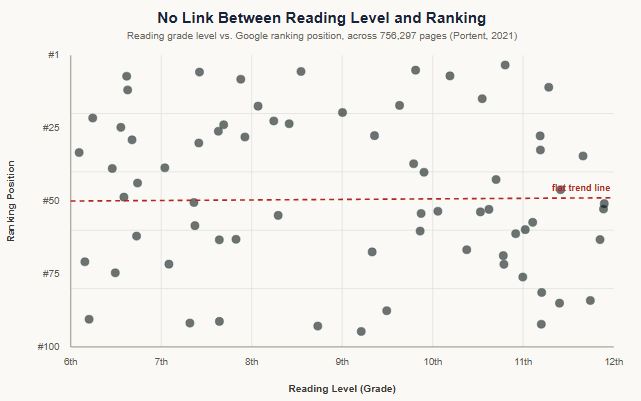
Most “readability doesn’t affect rankings” articles point to the same source: Portent’s 2021 analysis of 756,297 ranking pages, pulled from roughly 30,000 desktop search queries. It’s still the only large-scale study built specifically to answer this question. Everything else in the SEO content space is opinion dressed up as best practice.
The headline finding is the one everyone remembers: no link between a page’s reading level and its ranking position. The finding almost nobody repeats is more interesting. Across all 756,297 pages, the average reading level of content that ranks was 11th grade — several grade levels past the “write for a 6th-grader” advice recycled across SEO blogs for a decade.
| Readability claim | What the study actually found |
|---|---|
| Simpler content ranks higher | No link found, in either direction |
| Google rewards a specific grade level | No target grade level shows up in the data |
| Top-ranking content is written simply | Average reading level across ranking pages: 11th grade |
| Readability tools measure a ranking input | They measure writing quality, not anything Google scores |
It’s worth naming the shortcut that got readability tangled up with rankings. You’ll see a version of it across half the “readability matters for SEO” content out there: content quality affects rankings, readability affects content quality, so readability must affect rankings. That’s not proof. It’s a chain of maybes. And it’s worth noting that the loudest voices repeating it often sell the readability tool meant to “fix” the problem.
None of this means readability is irrelevant. It means the real mechanism works differently than most people assume — and that’s worth understanding.
Why Readability Still Matters for SEO, Even Though It Isn’t a Ranking Factor
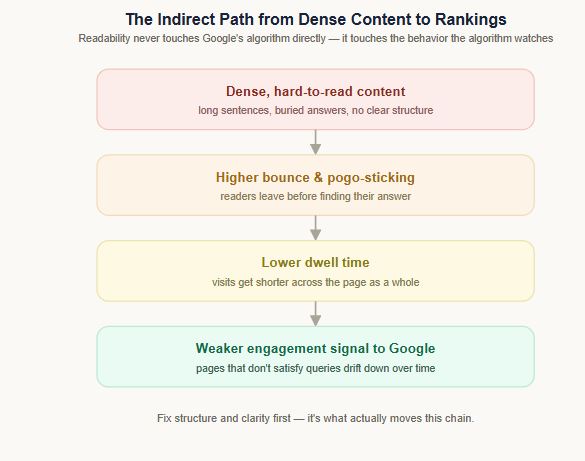
Readability affects rankings indirectly, through something Google does measure: how long someone stays on your page, and whether they click back to search results and try something else. That second behavior has a name in the industry — pogo-sticking. It’s a real signal that a page failed to satisfy the reader, even if the answer was technically there.
Here’s the honest version, stated plainly: dense, hard-to-parse content makes a visitor more likely to bounce before finding their answer. Enough of those bounces, and Google reads it as a page that didn’t satisfy the query. Pages like that drift down over time. Readability never touches the ranking algorithm directly. It touches the behavior the algorithm was already watching.
More recent statements from Google echo this shape. A Google Search Advocate has said that harder-to-understand content makes it harder for people to stay and keep reading, and that lower engagement can affect rankings indirectly over time. That’s a different claim than “readability is a ranking factor” — but it can produce a similar-looking outcome for a page that’s genuinely too dense for its audience.
| Factor | Direct Google ranking input? | Can influence rankings indirectly? |
|---|---|---|
| Flesch Reading Ease / grade-level score | No | No — the score itself isn’t tracked |
| Short sentences, plain words | No | Yes, through lower bounce and longer time on page |
| Clear headings, short paragraphs, lists | No | Yes, through easier skimming and less pogo-sticking |
| Matching complexity to your audience | No | Yes — mismatched complexity is what drives the bounce |
Pro tip: Want to know if readability is actually costing you anything? Skip the Flesch score. Check your bounce rate and average time on page for that specific URL instead. A high grade-level score paired with strong time on page usually means the content is dense and well-matched to its audience — which is a fine place to be.
Readability and E-E-A-T: Where the Two Actually Connect
Readability connects to E-E-A-T (Experience, Expertise, Authoritativeness, Trustworthiness) through Trust — the most heavily weighted of the four pillars. Google doesn’t score your Flesch number. But content that’s genuinely hard to read for its intended audience fails a basic test: was it built to help that reader at all?
Google’s Search Quality Rater Guidelines don’t mention Flesch Reading Ease by name. They do ask raters to judge whether content is actually usable by the people it’s written for.
This is also where “simpler is always better” quietly breaks down. A page written for tax attorneys that avoids the word “amortization” isn’t more trustworthy — it’s less accurate, and a specialist reader will notice immediately. Expertise, another E-E-A-T pillar, sometimes requires the harder read. The right readability target isn’t a fixed number. It’s whatever matches the vocabulary your actual reader already has.
Site owners who run this check on their own pages often find a pattern: product pages and landing copy tend to score easier on Flesch Reading Ease than long-form guides written for an already-informed reader. That gap is usually intentional, not a flaw to fix.
Related: our guide to writing genuinely plain, accessible content without dumbing it down.
Trust also means saying what you don’t know — which is a fair way into the newest, least-settled part of this question.
Does Readability Affect Whether AI Overviews Cite You?
There’s no confirmed scoring system connecting readability to AI Overview or chatbot citations. This is a newer, less-studied question than classic Google rankings. What the available evidence does show: generative engines favor short, self-contained, clearly structured answers over long or padded prose. That overlaps with readability without being the same thing.
Early research on AI citation behavior suggests a tightly structured, moderate-length piece — with clear question-and-answer sections — tends to out-cite a much longer article where the actual answer is buried in dense paragraphs. That’s a structure-and-density finding, not a vocabulary-simplicity finding. A technically precise sentence with clean structure around it can still be highly citable.
In practice, the habits that help AI citability aren’t “use smaller words.” They’re the same structural habits that help human skimmers: one idea per section, an early direct answer under each heading, short paragraphs. Vocabulary and structure are two different variables — and this is one more place people lump them together.
So What Should You Actually Do About Readability?
Treat readability as a writing-quality check, not a ranking lever. Calibrate it to the reader you actually have.
- Match your score to your audience, not a universal target. A consumer FAQ page and a technical documentation page shouldn’t share a Flesch target. Forcing one to match the other usually makes one of them worse.
- Fix structure before you fix vocabulary. Short paragraphs, real subheadings, and lists do more for both human skimmers and AI extraction than swapping “utilize” for “use.”
- Use readability as a bounce-rate diagnostic, not a publishing gate. High bounce and low time on page? Check readability alongside actual answer quality. Dense writing is one possible cause, not an automatic verdict.
- Stop chasing a specific number. There’s no Flesch score Google rewards. Run your draft through a checker to catch accidental complexity — not to hit a target that doesn’t exist on Google’s end.
Related: how word count and reading time actually relate to rankings.
The Bottom Line
Readability is not a Google ranking factor, and no tool measuring your Flesch score is measuring anything Google’s algorithm reads. What it measures is real anyway: whether the people you’re writing for can actually get through your page — which shapes the bounce and engagement signals Google does watch.
The study that settled the direct-factor question also revealed something the “write simpler” crowd rarely mentions: the content that actually ranks skews far denser than the advice claims it should be.
The practical move isn’t chasing a score. Run your draft through a readability check before you publish. Treat a jarring result as a signal to look closer, not a verdict to obey. Then match the final complexity to the reader who’s actually going to land on the page.
Check your draft’s Flesch Reading Ease score with our readability checker →
FAQ
What Flesch Reading Ease score should I aim for in a blog post? There’s no universal target Google rewards, so aim for your actual reader, not a benchmark. For a general consumer blog, 60–70 (roughly 8th–9th grade) works well, since it matches how most people skim on mobile. For a specialist or B2B audience, a lower score is fine and often more accurate. Write for the reader you have.
Does Yoast’s green readability light mean my content will rank better? No. Yoast’s readability check mirrors general writing-quality best practices, not a Google ranking input. A green light means the content follows the plugin’s internal style rules. It says nothing about where the page will rank — that’s driven by relevance, links, and how well the page satisfies the query.
Is longer content always better for SEO regardless of readability? No. Longer pages don’t outrank shorter ones by default, and padding that buries the actual answer works against you — especially for content that AI systems are trying to extract and cite. Length should match what the topic genuinely needs, with readability holding the piece together as it grows.
Does readability affect how content performs in AI Overviews specifically? There’s no confirmed scoring system for this yet, and it’s a newer, less-studied question than classic Google rankings. What is documented: generative engines favor clearly structured, self-contained answers over dense or padded prose, which overlaps with what makes content readable in the first place.
Should landing pages and blog posts target the same readability level? No. A landing page trying to win a decision in 30 seconds should generally read easier than an in-depth blog explainer, because the two pages serve different moments of attention. Match the score to the job the page is doing, not to one site-wide rule.