Last updated: August 1, 2026
If a grader ever docked your passive voice readability score without explaining why, here’s the direct answer: it isn’t grammar. The Flesch Reading Ease formula only checks two things — how long your sentences are, and how many syllables sit inside your words. It has no way to spot passive voice at all. So why do so many readability tools still flag passive sentences as a problem?
Here’s the pattern once you start checking sentence pairs: rewrite a passive sentence as active, and it almost always gets shorter. That one fact explains most of what follows: how to spot active vs passive voice fast, when to keep the passive version, and how to fix passive voice when it’s just adding weight to your writing.
In this guide:
- A quick refresher: how to spot passive voice
- Why does passive voice affect your readability score?
- When is passive voice the right choice?
- A 5-minute self-edit pass
- Before and after: a worked example
- FAQ
A quick refresher: how to spot passive voice
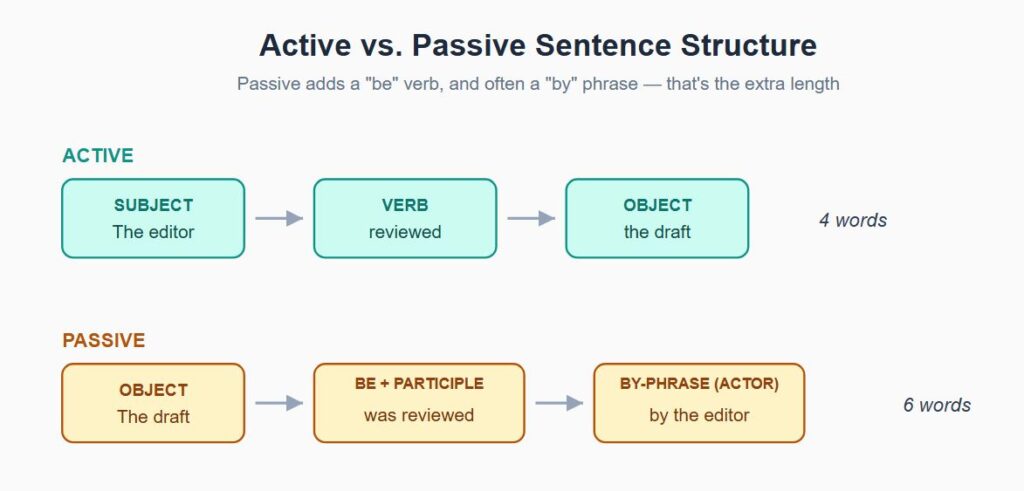
Active voice follows a simple order: subject, then verb, then object. The subject does the action.
Active: “The editor reviewed the draft.”
Passive voice flips that order. It often drops the subject entirely. The object moves to the front. The verb becomes a form of “be,” plus a past participle.
Passive: “The draft was reviewed by the editor.” Or, more evasively: “The draft was reviewed.”
Here’s the fastest way to catch passive voice in your own writing. Look for a “to be” verb — was, were, is, are, been — followed by a past participle. Often, a “by” phrase follows it, naming who did the action.
One quick test settles it: add “by zombies” after the verb. If the sentence still makes sense, it’s passive. “The draft was reviewed [by zombies]” still works. That’s the tell.
Why does passive voice affect your readability score?
Short answer: it doesn’t, not directly. Passive voice isn’t a separate input in the Flesch Reading Ease or Flesch-Kincaid Grade Level formulas. Both only measure two things — average sentence length and average syllables per word. Neither one can detect grammar.
The real connection runs through word count. Turning a sentence passive almost always adds words: an auxiliary verb like “was” or “has been,” and often a “by” phrase naming the actor. Compare:
Active: “John threw the ball.” (4 words) Passive: “The ball was thrown by John.” (6 words)
Repeat that pattern across a paragraph, and your average sentence length climbs. That’s the variable the readability formulas actually measure. Passive voice doesn’t get penalized because a formula understands grammar. It gets penalized because it tends to make sentences longer for the same amount of information.
That’s also why tools like Hemingway App and Yoast SEO flag passive voice separately, instead of folding it into one score. Our Flesch Reading Ease guide breaks down exactly what that formula counts, and what it ignores.
The bigger goal, either way, is plain, direct language: short sentences, familiar words, one idea per sentence. Passive voice is just one habit that works against that goal when it’s overused.
When is passive voice the right choice?
Knowing when to use passive voice comes down to three situations. Outside of them, active voice is the right default:
- The actor is unknown or doesn’t matter. “The package was delivered this morning” doesn’t need “by the delivery driver.” The reader doesn’t need that detail.
- The result matters more than who did it. “The suspect was arrested last night” puts the focus where the story needs it. “Police arrested the suspect last night” shifts focus away from the more newsworthy part.
- Scientific writing, in some cases. “The samples were heated to 80°C” keeps the focus on the process, not the person running it. Even here, though, the convention is shifting: Nature’s own author guidelines tell researchers to write in active voice, because direct sentences are easier for readers to follow — a preference that now reaches into methods sections too, not just results and discussion.
What passive voice shouldn’t do is hide accountability. “Mistakes were made” is the classic example — grammatically fine, but evasive, because it never says who made them. If skipping the actor is a deliberate, honest choice, passive voice is a legitimate tool. If it’s hiding who’s responsible, that’s the sentence to rewrite.
A 5-minute self-edit pass
Run this over any draft:
- Search for “was,” “were,” “is,” “are,” and “been.” These flag most passive constructions.
- Check each one for a “by” phrase, or a missing actor. If the actor is there and it matters, that’s your cue to switch to active.
- Ask: does the reader need to know who’s doing this? If yes, and it’s missing, add the actor and switch to active. If no, passive might already be the clearer choice.
- Count the words in both versions. If the active rewrite is shorter and just as clear, use it. That’s also the version that nudges your readability score.
Google’s own technical writing style guide takes the same stance: default to active voice, because it’s usually clearer, more direct, and shorter. Save passive voice for the cases above.
For more ways to trim word count without losing meaning, see our guide to writing shorter sentences.
Before and after: a worked example
Before (passive-heavy): “It was determined by the review committee that the proposal would not be approved, and further revisions were recommended before resubmission would be considered.”
That’s 24 words, one sentence, and three passive constructions stacked on top of each other.
After (active): “The review committee rejected the proposal and recommended revisions before resubmission.”
That’s 11 words — less than half the length, with the same information and the same sentence count. No facts got cut. Each passive construction was just carrying extra weight: an auxiliary verb, an implied actor, a longer path to the point. Moving the actor to the front of the sentence removed all of that at once.
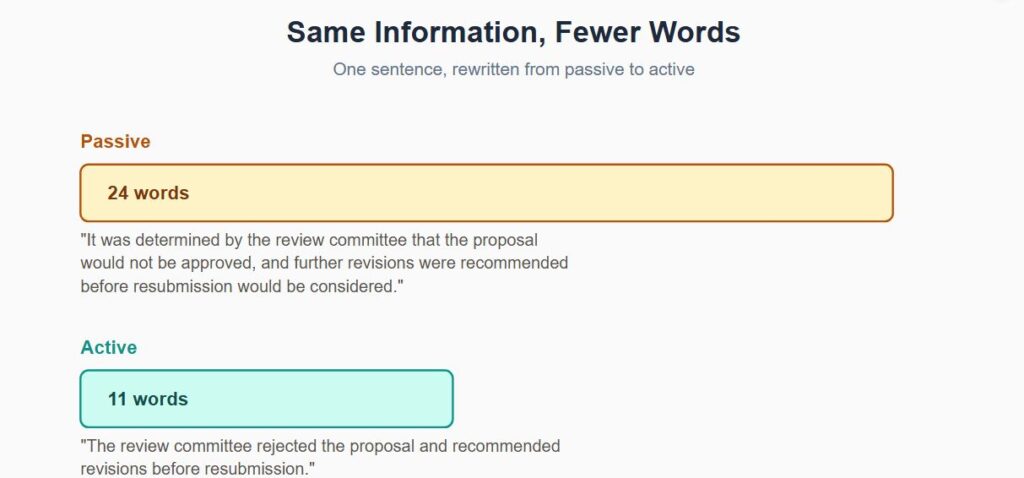
That drop in sentence length is what shows up as a better Flesch-Kincaid Grade Level. The passive-to-active rewrite is the tool. Shorter, simpler sentences are the actual cause.
FAQ
Does passive voice directly lower my Flesch Reading Ease score? Not directly. The formula only measures sentence length and syllables per word — it can’t detect grammar. Passive voice tends to add words to a sentence, and that’s what actually moves the score.
How do I quickly find passive voice in my writing? Search for “was,” “were,” “is,” “are,” or “been” followed by a past participle. Then run the zombie test: add “by zombies” after the verb. If the sentence still works, it’s passive.
Is passive voice ever the right choice? Yes. Use it when the actor is unknown, irrelevant, or less important than the result of the action — in some scientific writing, for instance, or when a story’s focus belongs on what happened rather than who did it.
Why do Yoast and Hemingway flag passive voice separately from the readability score? Because passive voice isn’t part of the Flesch formula itself. These tools run a separate grammar check alongside the score. They don’t fold it into the score’s calculation.
Try it on your own draft
Passive voice isn’t wrong. It’s also not directly counted by any Flesch-based readability score. But it tends to add words, and word count is exactly what those formulas measure.
Use the zombie test to spot passive voice fast. Keep it when the actor genuinely doesn’t matter. Switch to active whenever accountability or brevity matters more.
Curious what your own passive voice readability score actually looks like? Run your draft through ChronoLedger’s free readability checker and see how passive-heavy sentences are affecting the number.
Pingback: How to Count Words in an Essay, Book, or Blog Post - chronoledger.site
Pingback: Dale-Chall Readability Formula: How It Differs From Flesch-Kincaid
Pingback: How to Write Shorter Sentences Without Losing Meaning - chronoledger.site