You check the word count. It says 1,742. Or 1,860. The assignment caps you at 1,500 words — maybe with a little wiggle room, maybe not. Now you’re staring at an essay that says everything you meant to say, just in too many words.
The instinct is to start cutting wherever the cursor lands. That’s how a sentence that actually mattered gets deleted, while three weak ones survive three paragraphs later. Trimming well isn’t about deleting words until the counter hits the right number. It’s about knowing which 200 to 300 words are doing no work at all, and cutting exactly those, in the right order.
It’s worth doing properly for a reason beyond the rubric, too. A 2019 meta-analysis pooled 190 studies on reading speed and put average adult silent reading at about 238 words per minute. So 300 extra words is over a minute of extra reading — for every essay in the stack your grader has to get through. Trimming isn’t just compliance. It’s the difference between an essay that reads as tight and one that reads as padded, even when the argument underneath is identical.
Here’s the order that actually works. Cheapest cuts first, biggest payoff first.
Step 1: Read for Repeated Arguments First
This is the biggest single cut, and almost nobody starts here. Most people start with the introduction, because it’s page one. Start with repetition instead. It’s usually worth more words, and it won’t cost you any argument quality.
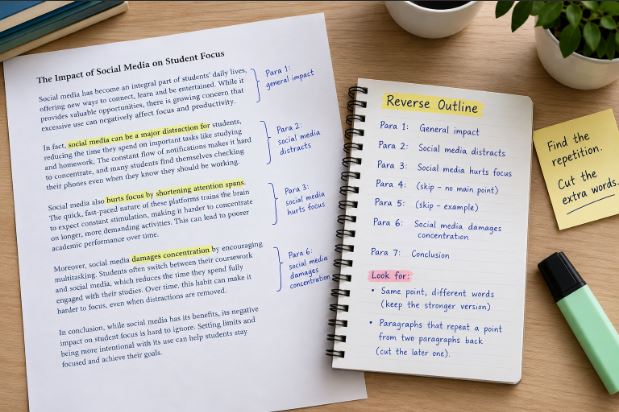
Writing centers call this technique reverse outlining. Purdue’s OWL, UNC’s Writing Center, and the University of Wisconsin–Madison’s Writing Center all teach some version of it. Here’s how it works: go through your essay paragraph by paragraph. Next to each one, jot down its main point in just a few words. When you’re done, read only those notes, top to bottom. That’s the skeleton of your argument.
Two things tend to jump out. First, any point you made twice — once early and hedged, once later and confident. Keep the stronger version. Cut the first one. Second, any paragraph whose note basically repeats one from two paragraphs back. That’s a sign you circled back instead of moving forward.
For example, say your margin notes read “para 3: social media hurts focus” and “para 6: social media damages concentration.” That’s the same point twice, just reworded. One of those paragraphs — and everything supporting it — can go.
In a 1,500-word essay, this step alone often recovers 150 to 300 words. Repeated arguments tend to drag their supporting sentences along with them.
Step 2: Trim Your Introduction and Conclusion
Do this after Step 1, not before. The intro and conclusion are the most visible bloat, but they’re rarely the biggest.
For a 1,500-word essay, a working rule is that your intro and conclusion together should land around 18 to 22% of the total — roughly 150 to 180 words for the intro, and 120 to 150 for the conclusion. If yours run longer, it’s usually one of two problems: the intro clears its throat before making the actual claim, or the conclusion re-explains the whole argument instead of just restating it.
Watch for sentences like “Throughout history, people have debated…” Cut lines like that entirely — don’t just shorten them. A trimmed-down version of a sentence that shouldn’t exist is still a sentence that shouldn’t exist.
Step 3: Cut One Weak Example Per Section
If a body paragraph uses two or three examples, one of them is probably there because you found it — not because the paragraph needed it. Go section by section and ask: if I cut the weakest example here, does the paragraph’s claim still hold up? Almost always, yes, because the strongest example was already carrying the argument. The others were reinforcement, not evidence.
This isn’t the same as cutting evidence broadly. You’re not thinning the argument. You’re removing the example that was there for volume. A paragraph with one strong, specific example reads as more confident than one with three medium ones — readers trust a writer who commits to their best evidence more than one who hedges with a pile of it.
A fast way to spot the weak one: it’s usually introduced with a hedge, like “some might argue” or “another instance could be.” If you’re softening the setup, that’s often the sentence to cut.
Do this across four or five body paragraphs, and you’ll typically free up another 150 to 250 words — without touching your thesis or your best evidence.
Step 4: Tighten Transitions Between Paragraphs
This is where the smallest cuts live, and they add up faster than you’d expect. “In addition.” “Furthermore.” “It is also worth noting that.” “Moving on to the next point.” None of these are wrong on their own. But stacked across a 1,500-word essay, they can quietly cost you 40 to 80 words — words a sharper first sentence would replace for free.
Try this: read the first sentence of each body paragraph on its own, out of context. If it only makes sense because of the transition phrase propping it up, rewrite it so it stands on its own. Let the content do the connecting work, not a stock phrase.
For example, instead of “In addition, social media also affects sleep,” try “Social media cuts into sleep the same way it cuts into focus.” Same idea, no filler word doing the linking for you.
Step 5: Final Word-Count Check and Paragraph Rebalance
Once you’ve made the cuts above, recount your words — don’t estimate. Then do one more pass that has nothing to do with word count: check whether your paragraphs are roughly balanced. Any paragraph that runs noticeably longer than the rest is worth a second look. It’s often covering two ideas that should be split, or it’s still carrying weight your earlier cuts didn’t fully remove.
For reference: 1,500 words in a standard academic format — 12-point font, double-spaced, one-inch margins — runs to about six pages, or three pages single-spaced. If your page count looks off after trimming, check for stray leftovers: an orphaned heading, or a transition sentence pointing at a paragraph that no longer exists.
The Takeaway
Most essays that run 200 to 300 words over their limit aren’t over because they have too much to say. They’re over because a point got made twice, the intro took too long to reach its claim, or an extra example got kept out of habit rather than need.
Cut in this order: repetition, then intro and conclusion, then weak examples, then transitions. Do that, and you’ll almost always land at your target without losing anything the essay actually needed.
One last step: read it out loud before you submit. If a sentence doesn’t earn its place when you hear it, it wasn’t going to earn it on the page either.
Related Posts:
Pingback: Punctuation Checker: 7 Common Mistakes (and What It Misses)